

Perforated Cable Tray Straight
Straight ventilated tray lengths that form the main run of a cable route.
View Perforated Cable Trays →EnquireCable Tray Catalog
See the size and finish checklist →
Compare cable tray profiles and specify fittings and supports for commercial and industrial projects across Pakistan. Use the catalog below to prepare a drawing or bill of quantities for your quote.
Compare tray profiles or use the size guide to put your dimensions into a quote.
Product Range
Straight runs, bends, branches and junctions — the pieces that make up a complete cable tray system. Pick the item you need and send an enquiry with your required size.
Straight ventilated tray lengths that form the main run of a cable route.
View Perforated Cable Trays →Enquire
Four-way perforated fitting where two cable routes cross each other.
Enquire


Open-rung ladder tray for strong support and free airflow around cables.
View Ladder Cable Trays →Enquire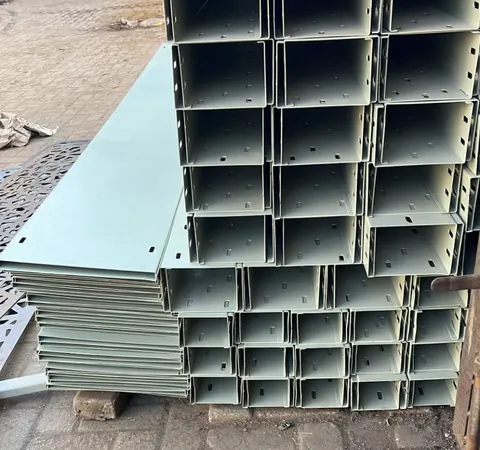
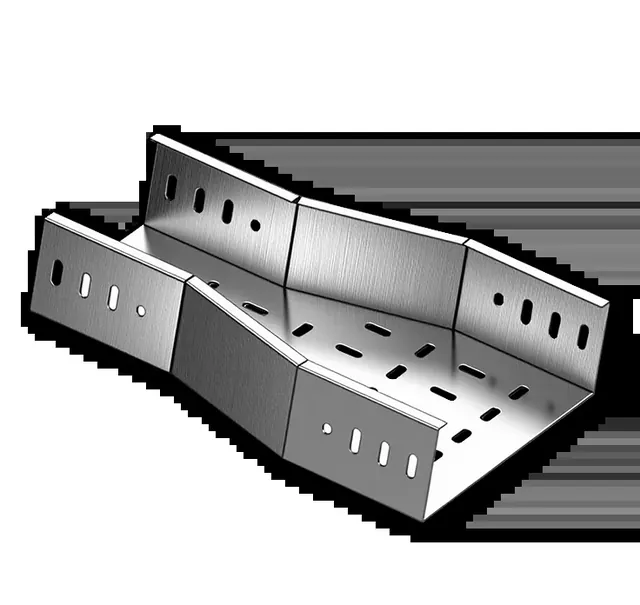
Perforated fitting that joins a wider tray run to a narrower one.
View fitting details →Enquire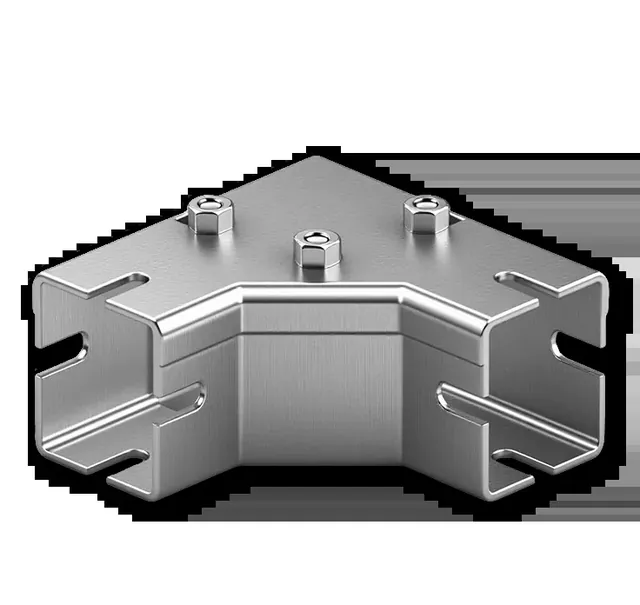
Flat 90-degree bend that turns a tray run left or right on the same level.
View fitting details →Enquire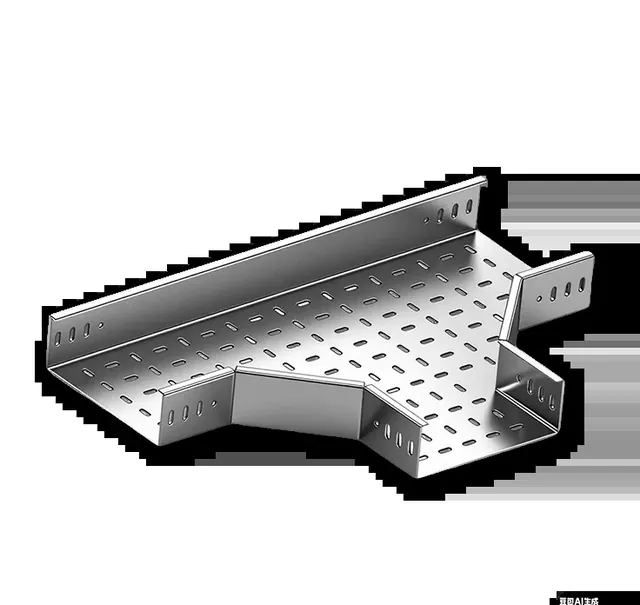
One enquiry can cover the complete system — trays, fittings, covers and supports. These are the options buyers usually choose from:
Perforated • Ladder • Wire Mesh • Solid Bottom / Trunking • Marine • Leddar
Galvanized Iron (GI) • Mild Steel (MS) • Stainless Steel (SS)
Pre-Galvanized • Hot-Dip Galvanized (HDG) • Powder-Coated
Industrial plants • Commercial buildings • Data centers • Infrastructure projects • Solar & power projects
Exact sizes, finishes and models are confirmed on enquiry — share your required width, side height, length and thickness with your request.
Choose a Profile
Each profile suits a different job. Tell us which one your project specifies — or describe the route and we will review it with you.
A sheet-metal channel with punched openings across its base. The perforations let air move around the cables, so heat escapes instead of building up inside the run.
Share your required width, side height, length and thickness.
Enquire →Two side rails joined by open rungs. Cables rest on the rungs with open space between them, giving both strong support and ventilation along long runs.
Share your required width, side height, length and thickness.
Enquire →An open grid of welded steel wires. Light to handle, quick to cut and join on site, and easy to inspect or re-route when cables change.
Share your required width, side height, length and finish.
Enquire →A continuous solid base, usually fitted with a cover, that shields cables from dust, drips and knocks along the whole route.
Share the internal size, route layout and cover requirements.
Enquire →Trays formed from galvanized-iron sheet — chosen where the strength of steel and the durability of a zinc-coated surface are both needed.
Share the tray profile, required dimensions and quantity.
Enquire →A ladder-style riser for vertical cable runs between floors. Cables stay separated and untangled as they travel up or down the building, with the same open-rung ventilation as a ladder tray.
Share the floor-to-floor height, width and cable load.
Enquire →The sizes most commonly asked for, in millimetres and inches. Trays are generally available in widths from 50–1000 mm with side heights from 50–150 mm, and custom sizes can be made on request.
| Width (mm) | Side Height (mm) | Width (inches) | Side Height (inches) |
|---|---|---|---|
| 100 | 75 | 4″ | 3″ |
| 150 | 75 | 6″ | 3″ |
| 200 | 75 | 8″ | 3″ |
| 300 | 75 | 12″ | 3″ |
| 300 | 100 | 12″ | 4″ |
| 450 | 100 | 18″ | 4″ |
| 600 | 100 | 24″ | 4″ |
| 600 | 150 | 24″ | 6″ |
| 900 | 150 | 36″ | 6″ |
Other sizes made to order — share your required size in your enquiry. Exact sizes, finishes and models are confirmed on enquiry.
A quick planning figure for transport and support design. The exact weight of your order is confirmed on enquiry.
Materials & Finishes
The material decides how long a tray lasts on your site. These are the usual choices — if your project specification names one, use that.
The general-purpose choice for indoor industrial and commercial runs — strong and economical, usually finished galvanized or powder-coated for protection.
Share the tray profile, dimensions and finish.
Enquire →Zinc-coated steel for damp or corrosive sites — the standard pick where rust protection matters, indoors and out.
Share the tray profile, dimensions and quantity.
Enquire →For sites with strict hygiene rules or chemical exposure — food processing, pharmaceutical and petrochemical plants. The highest corrosion resistance of the range.
Share the grade, if your specification names one.
Enquire →A thick zinc coating for outdoor and harsh exposure — construction sites, oil and gas facilities, bridges and marine work.
Share the tray profile, dimensions and quantity.
Enquire →Finishes: pre-galvanized, hot-dip galvanized and powder-coated. For outdoor runs, stainless steel, hot-dip galvanized or pre-galvanized trays are the usual choice — describe the site conditions in your enquiry and the finish can be reviewed with you.
Complete the Run
Fittings turn straight lengths into a working route. Add the ones your layout needs to the same enquiry — with the type, size and quantity for each.
Turns the tray run left or right while staying on the same level.
Takes the run up or down where the route changes height.
Connects three tray sections, branching one route off the main run.
Connects four tray sections where two routes cross.
Joins tray sections of different widths within the same run.
Joins two straight sections together into one continuous run.
Clips over the tray for extra protection of the cables inside.
Holds the tray to a wall or structure at the required height.
Closes off the end of a tray run for a neat, safe finish.
Fix cables and tray sections firmly in place along the route.
Hold It Up
Every run needs support. These are the support items buyers commonly include in the same enquiry — share your mounting arrangement and support details from your drawing.
Slotted angle sections used to build frames and support structures for tray runs.
Slotted channel that carries trays and gives flexible fixing points along its length.
Hangs trays from ceilings and slabs, adjusted to the height your route needs.
Cantilever arms fixed to channel or walls that carry the tray from one side.
Slotted steel channel that forms the backbone of tray support frames — the same framing used for tray supports, HVAC runs and solar mounting structures.
Brackets that hold tray runs directly against walls.
Hanging assemblies that suspend tray runs below roofs and ceilings.
Stands and frames that carry tray runs up from the floor.
In the Workshop
From raw sheet to finished tray — the six stages every order passes through.
The sheet material specified for your order is selected and cut to size.
Cut sheets are folded and formed into the tray profile and side rails.
Ventilation slots and fixing holes are punched into the formed sections.
Rungs, rails and fittings are welded and assembled to your requirement.
The finish you specified is applied to protect the steel — galvanized or coated, as ordered.
Your order is checked against your requirement before it is handed over.
Beyond the Catalogue
Not every route fits standard parts. These are the custom jobs buyers commonly ask about — send your layout and the details can be reviewed before you order.
Trays vs Conduit
Conduit still has its place — but for most large cable routes, open trays win on installation, cooling and maintenance.
Trays go up quicker than conduit runs, and new cables can be laid in without pulling anything apart.
Add or remove cables later without replacing the run — the open system grows with the building.
Open trays let heat escape instead of building up inside a closed pipe.
Cables are visible along the whole route, so faults are found and fixed faster.
Less labour to install and maintain than conduit, especially on large projects.
Unlike closed pipes, open trays do not trap toxic gases — and there is no condensation build-up inside the run.
Safety
Metal tray runs are earthed to prevent electric shock. The usual practice, following your project specification:
A copper or galvanized-steel wire mesh is fixed along the tray run.
Each tray section is tightly connected to the next, so the whole run is one continuous conductor.
The mesh is connected to the installation’s main grounding bar.
Grounding terminals on each section hold the mesh firmly in place.
Earthing work must follow your project specification and be carried out by a qualified electrician.
Before You Enquire
Include these five details and your quote can be prepared without back-and-forth. Missing one? Send what you have — the rest can be confirmed in reply.
Note: The tray types and products above are enquiry categories — Tawakkal Enterprises’ exact sizes, finishes and models are confirmed on enquiry. Send your required dimensions with your request and we will confirm availability.
What affects the price: tray type, material grade and thickness, finish, and order quantity. Quotes are normally worked out per metre from your specification — send the details above for an exact figure.
Cable Tray Questions
Share the tray profile, width, side height, length, material, finish, quantity and any fittings you need.
A perforated tray has a ventilated sheet base. A ladder tray uses open rungs. Use the profile specified for your cable route.
Yes. List the type, size and quantity for each item in your cable tray request.
Yes. Send the required dimensions, quantity and drawing reference so availability can be checked.
Use the material and finish in your project specification. If you are unsure, describe the installation environment in your enquiry.
Match the tray to the cable load, the installation environment, the cable type, and how much corrosion protection the site needs — and leave room for future cables. Describe the route in your enquiry if you are unsure.
Yes, when the tray is designed and supported for the load. Share the cable sizes and load criteria from your project specification so the thickness and support spacing can be reviewed.
At least once a year — check the tray, supports and fixings, and look for corrosion or damage, especially on outdoor runs.
Very little. Periodic cleaning and inspection are usually enough to keep a tray system in good condition.
Yes. Cables can be added to or removed from an open tray run without replacing it, which makes future expansion straightforward.
Send your tray type, sizes and quantities — we will review your requirement and reply with your quote on WhatsApp.
Get a printable summary of tray profiles, sample dimensions, fittings and the information to send for a quote.
Start with the tray profile and dimensions in your drawing. For each run, give the width, side height, straight section length and metal thickness. Use separate lines for fittings, supports and covers.
| Type | Profile | Quote inputs |
|---|---|---|
| Perforated tray | Slotted base and raised sides | Width, side height, length, thickness and finish |
| Ladder tray | Open cross-rungs between side rails | Clear width, rail height, rung spacing and support layout |
| Wire mesh tray | Open wire basket | Width, depth, route and joining parts |
| Trunking | Enclosed route with access through removable covers | Width, depth, cover requirement and fittings |
Finish options listed in our catalog include pre-galvanized, hot-dip galvanized and powder-coated. Confirm the material, finish and section lengths for your order; list any non-standard requirement on the drawing.
Use the cable tray size guide or contact the Shershah workshop to discuss a project.